

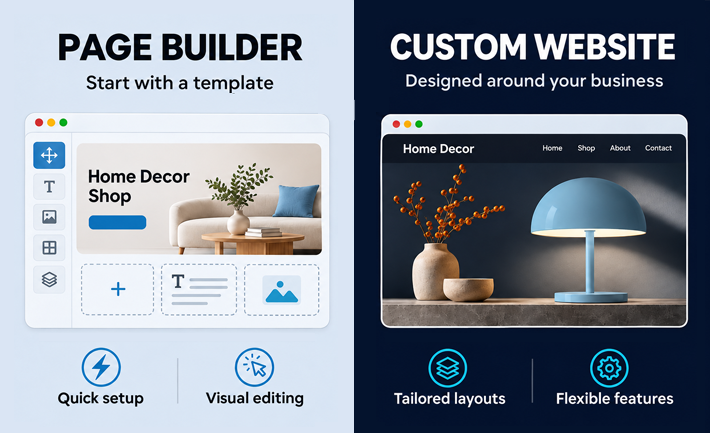
A website builder offers a practical way to create and manage a small business website using templates and a visual editor. A custom website gives a business more control over how its brand, services, and work are presented. Both approaches can produce a professional site. The better fit depends on what the website needs to do, who will maintain it, and how much flexibility the business needs.
What is a website builder?
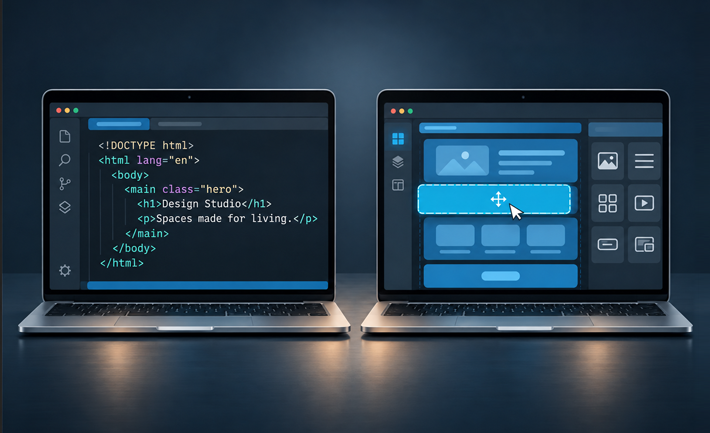
A website builder combines templates, a visual editor, and often hosting in one service. A business can choose a layout, add its own content, and make routine updates through the editor. This can be a practical option for a business that needs a few informational pages, a contact form, and a straightforward launch.
The features available vary by platform and plan. Online booking, e-commerce, or connections to other business tools may require a higher subscription tier or a paid add-on. Export options also vary, which matters if the business later decides to move the website elsewhere.
What is a custom website?
A custom website is designed around a business’s specific needs. Its page structure, typography, imagery, and navigation can be planned together to reflect the brand and help customers find the information they need.
For a remodeling company, that might mean organizing completed projects by service, pairing before-and-after photos with project descriptions, and placing an estimate request on each relevant service page. A builder may also support these features. The advantage of custom design is greater control over how they fit together and how prominently each one appears.
Custom design usually involves more planning and a higher initial investment. Day-to-day editing depends on how the site is built. A custom website with a content management system can let staff update project photos, service descriptions, and other content themselves.
Website builder vs. custom website at a glance
| Factor | Website builder | Custom website |
|---|---|---|
| Upfront cost | Often lower when the business handles setup | Usually higher due to planning, design, and development |
| Ongoing costs | Subscription fees and any paid add-ons | Hosting, maintenance, and any software or support fees |
| Design flexibility | Depends on the platform’s templates and editing tools | Layouts and page structure can be tailored to the business |
| Content updates | Generally handled through a built-in visual editor | Depends on the content management system and editing setup |
| Future changes | Limited to available platform features and integrations | Can accommodate more specialized features, with additional work as needed |
What Are the Design Limits of a Website Builder?
A website builder is software with its own templates, layout controls, and rules for how page elements behave. Those tools make common edits easier, such as updating photos or rearranging sections. More specific changes, such as designing a project gallery that works differently on mobile, depend on what the platform allows. Some changes may require an add-on or custom code.
These limits matter most when a business has a specific way it needs to present its work. A few standard layouts may be enough for a simple service site. A portfolio with several project types, detailed case studies, and different inquiry forms may call for more design control.
Which Is Better for SEO: A Custom Website or a Website Builder?
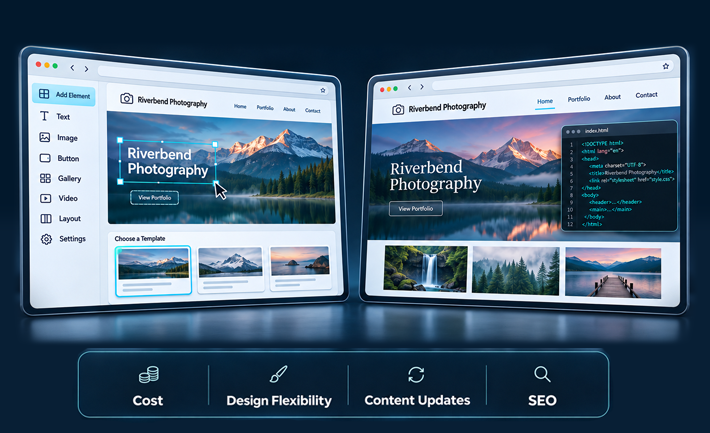
Either approach can support SEO. A website builder can meet the needs of many small businesses if it allows editable page titles, clear URLs, internal links, and redirects. A custom website offers more control over page structure and how pages load when the business has requirements that a builder cannot readily accommodate.
Useful content matters with either approach. A dedicated kitchen remodeling page, for example, can show completed projects, explain the process, and list the areas the company serves. It gives prospective customers more information than a brief mention on a general services page.
For a redesign, review which existing pages already bring in search traffic and inquiries. Keep those URLs where practical and set up redirects for any pages that need to move.
Which Option Makes Sense for a Small Business?
A website builder can be a sensible choice when the site has a limited scope, the business needs to launch quickly, and staff want to manage routine updates in one place. It helps to check the ongoing cost of the plan that includes the features the business actually needs.
A custom website is worth considering when the site needs to showcase a substantial portfolio, explain several distinct services, or give prospective customers enough information to submit a well-informed inquiry. The project scope should also clarify who can update the site and what ongoing support is available.
Final Thoughts
Start with what customers need to see and do on the website. If the available templates and tools support those tasks, a website builder may be enough. If the business needs more control over how it presents its services and work, custom design can be worth the investment.
Orange Graphics designs custom websites for businesses that want to present their services clearly and attract the right project inquiries.
To discuss a new website or a redesign, visit https://orangegraphics.us/.